  1. Blog
  2. Article

Canonical
on 3 August 2017

Upgrading your Ubuntu-on-Windows install to the app version


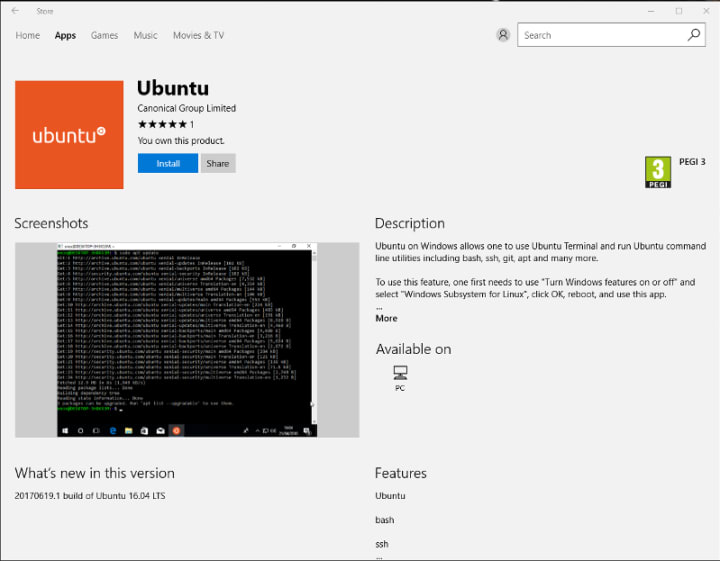
Our team and Microsoft recently released Ubuntu as a Windows app store application! If you toyed with the “bash on Ubuntu on Windows” version before and would like to try the latest and greatest, read on!
Saving your data

If your “bash on ubuntu on windows” environment has some data you’d like to keep, make sure you back it up now. The uninstall process will nuke everything.

Uninstall the old way

This is relatively simple. Opening a command line (cmd.exe) terminal and typing

lxrun /uninstall

will destroy your previous environment.

Installing the new way

To find the app in the Microsoft store, just type “Ubuntu” in the search bar. Click install. Voilà!

Related posts


Luci Stanescu
14 May 2026

Fragnesia Linux kernel local privilege escalation vulnerability mitigations

Ubuntu Article

A local privilege escalation (LPE) vulnerability affecting the Linux kernel has been publicly disclosed on May 13, 2026. The vulnerability does not have a CVE ID published, but is referred to as “Fragnesia.”  The vulnerability affects multiple Linux distributions, including all Ubuntu releases. The affected components are the Linux kernel ...


Bertrand Boisseau
13 May 2026

Rethinking BYOD security: protecting data without trusting devices

Ubuntu Article

BYOD (bring your own device) has always looked better on paper than it does in real life. The promise is clear: let people use the gadgets they already own. Less friction, lower costs, and more freedom. But when security and privacy are non-negotiable, the conversation around BYOD usually ends quickly. Not because BYOD is a ...


Luci Stanescu
8 May 2026

Dirty Frag Linux kernel local privilege escalation vulnerability mitigations

Ubuntu Article

Two local privilege escalation (LPE) vulnerabilities affecting the Linux kernel have been publicly disclosed on May 7, 2026. The vulnerabilities have been assigned the IDs CVE-2026-43284 and CVE-2026-43500 and are referred to as “Dirty Frag.” The affected components are Linux kernel modules. The first vulnerability impacts the modules tha ...